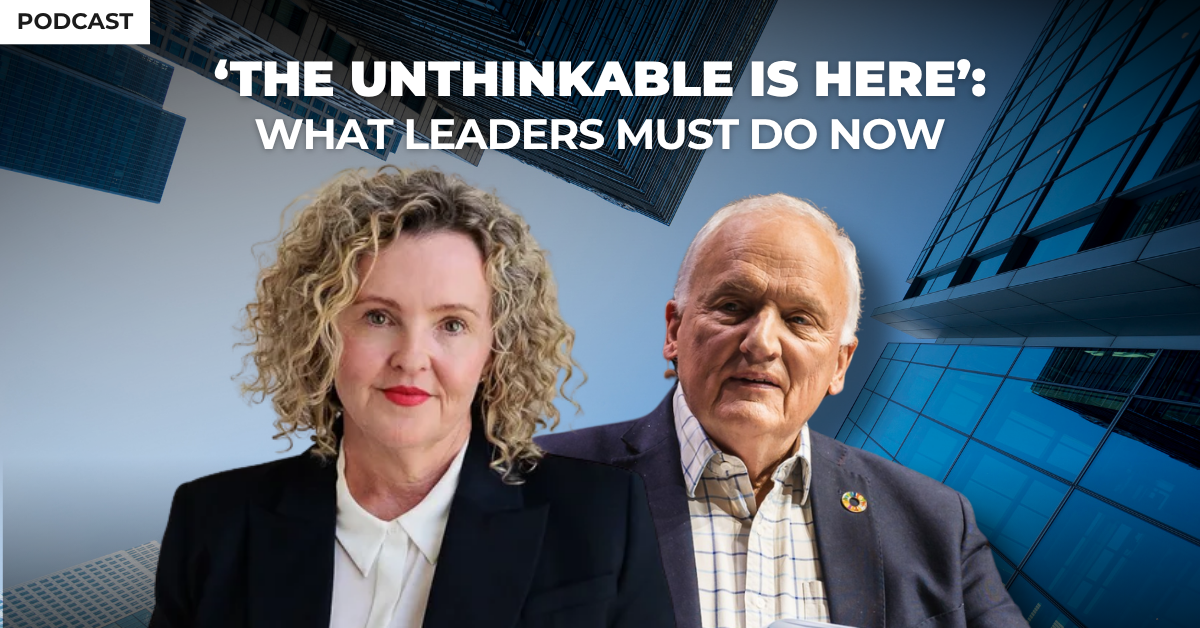
“The world is moving forward, and we are not going backwards.” says Leah Seligmann, Chief Change Catalyst and CEO at The B Team. “The opportunity is an economic transformation that will create jobs, wealth, and excitement.”
Headlines are dominated by climate backlash and political resistance. But Leah’s message is refreshingly optimistic and strategically positive. With a big smile she had told a gathering of sustainability leaders in Davos just as President Trump was being inaugurated that “we are moving and grooving. We are not going to go backwards”.
The evidence? Real progress is happening but there is not enough shouting about it.
The B Team is a collective of influential business and civil society leaders. For ten years it has been driving forward new models of leadership in ways that are grounded, resilient, and sometimes quiet.
This quiet momentum is part of a growing phenomenon some call greenhushing. Companies deliberately keeping quiet about their positive sustainability efforts to avoid politicization, backlash, or greenwashing accusations.
That’s not a bad thing, says Leah. In fact, it might be the key to building bridges and regaining trust.
“So much of the news that we get is negative — down, down, down, down, down. And the truth is that that only tells one piece of the story,” she explains. “The signals that we are seeing, the signals of changes, is that more and more is going forward.”
“Climate change is the existential threat we face,” But this forward motion is being driven by business leaders across major markets, even in countries with strong fossil fuel legacies.
“Just this week, there was new polling released by We Mean Business Coalition… and they found that 97% of these business leaders are actually in favour of shifting off of fossil fuels.” Hence the need to be positive. “The will and the excitement still exist within leadership.”
That quiet enthusiasm is translating into tangible change, not through big announcements, but through steady, strategic transformation.
“This is a global move to modernize, to innovate, to create and that’s where the money is going to be made,” says Leah. “That’s why you still see significant progress on the movement of clean energy, transition of more smart, sustainable agriculture, because it just makes business sense.”
None of this is about denial or magical thinking. It’s about realism, strategy, and emotional intelligence, especially in today’s divided world.
“We have an opportunity to bring new energy towards bridge building,” Leah says, “towards making it so that people see the sustainable economy as the economy that takes care of people… instead of it being a threat.”
At the heart of this lies a deeper cultural challenge: a collapse of dialogue, and a loss of shared narrative.
“What we’ve gotten lost in is this idea that a sort of fringe view holds the view of the majority,” Leah tells out podcast. “We’ve lost space for debate. We’ve lost space for an activism of bringing people together and engaging with people that you don’t know so well.”
She advocates more connection and collaboration rather than forcing louder messaging. “Debate is what has brought society forward time and time again, because not one person has the answer. There isn’t a silver bullet on any of these topics. It’s going to require engagement and conversation and understanding.”
And the language used to promote sustainability is a major part of the problem. “The narrative has been completely co-opted,” she says. “ESG, DEI; those things don’t mean anything. What the meaning is, is underneath it.”
Like many others who have appeared on our podcast, Leah says stripping away jargon is a key to bringing the possibilities back to basics. “It’s about taking care of . . . your people, your places, loving where you live.”
So yes, progress may be quieter than some expect. But it’s real, and it’s rising. So don’t despair.
“What we need to think about are really two pieces of it,” she explains. “One, why does this… make businesses more competitive, make economies more competitive, make countries more competitive? And… how does it impact people? How are we taking care of our people?”
At its core, Leah believes this movement is driven by something deeply human: care. “There are very few people that you will ever meet that wake up wanting to make the world worse for someone they know.”
In a world where loud voices dominate headlines, Seligmann and The B Team are proving that real change doesn’t always have to come with a megaphone.
The B Team and Leah are proving that “moving and grooving” works, even if perceptions are otherwise!

Leah Seligman
Leah Seligmann is a Chief Change Catalyst & CEO of The B Team, where she drives bold business action for a just and sustainable future. With a background as NRG Energy’s first Chief Sustainability Officer and as a consultant to global brands, she brings deep expertise in integrating sustainability into corporate strategy.
If you would like to contact our guest, you can do so by clicking on the button below.