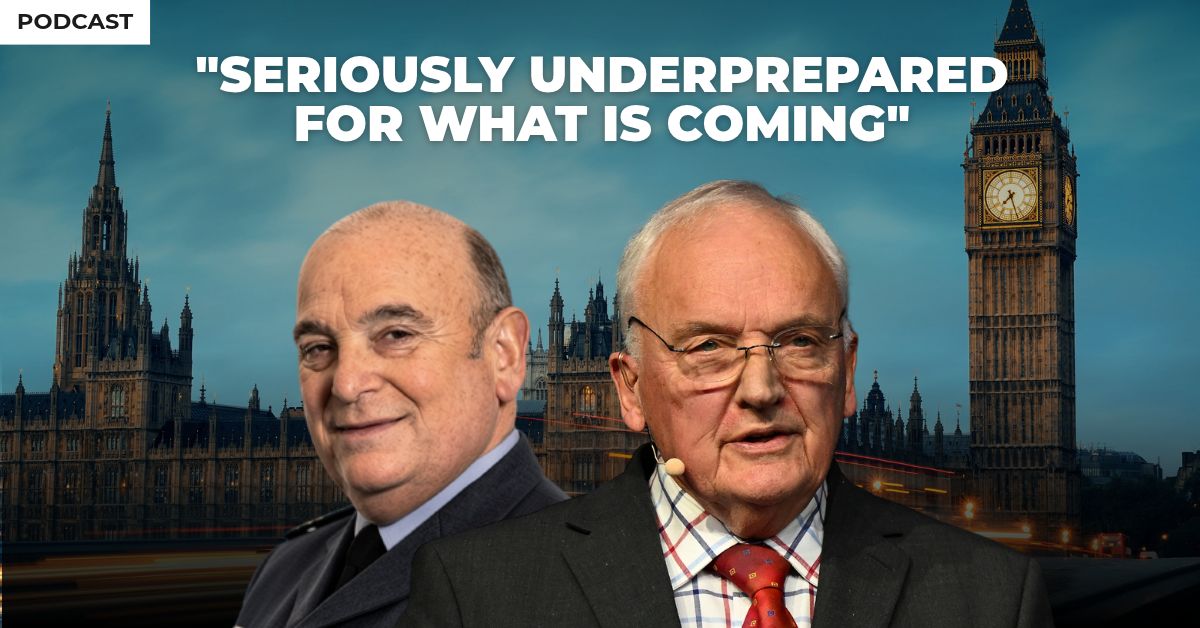
Seriously underprepared but no need to panic. Yet!
Britain must no longer treat national resilience as a “distant or hypothetical problem”. We are in a ruptured world where threats from Russia, Iran, and China collide with cyber attacks, sabotage, climate and biodiversity stress, plus much more.
The House of Lords National Resilience Committee in the UK has just issued a damning and scary new report. It warns that the UK is ”seriously underprepared” and nothing like resilient enough in its attitude to what looms.
Lord Stu Peach is a member of the committee. He is a former Chief of Defence in the UK, and former chair of NATO’s military committee.
In this podcast he strips bare the scale of national vulnerability for TTU’s Nik Gowing. So listen in and learn!
Don’t be squeamish!
Following a 10 month inquiry drawing on evidence from over 150 witnesses, the report urges that the government must no longer be “squeamish”. They must come clean with the public so they know the scale of what threatens the stability they take for granted.
As Lord Peach tells Nik, “the range and the urgency of the threats and risks we face makes it essential to have a national conversation.”
He warns: “It’s a wake up call for us to prepare to defend our way of life.” From maritime choke points to European rivers drying up to the stark reality that the UK imports all of its antibiotics, Britain’s reliance on vulnerable, just in time supply chains leaves critical infrastructure exposed.
Listen to Lord Peach explain why resilience must go far beyond stacking extra tins of food in the larder, and why the UK already possesses the “muscle memory” to come together and prepare before an existential crisis for survival strikes.
“Prevention is better than cure,” Lord Peach argues. Just as banks were forced to undergo rigorous stress testing after the 2008 financial crisis, the UK must now stress test society as a whole, bringing in the private sector, reviving Cold War style command structures, and embedding civic duty into the national curriculum.
Exposed Supply Chains and Choke Points
Britain has built sophisticated life support systems with minimal indigenous production. So the nation relies heavily on vulnerable maritime routes. Lord Peach points out how conflict and climate emergency are crashing together at global choke points:
Low water levels in dams above the Panama Canal and across European river systems are forcing cargo loads down. Conflict is diverting shipping away from the Suez Canal and around Africa, while over 200 tankers have been hit this year alone. Vital food, energy, and medicine logistics, including 100% of the UK’s imported antibiotics, depend on a handful of facilities needing urgent physical and cyber protection.
Beyond Extra Tins of Food: Build a Culture of Resilience
Drawing on NATO’s Article 3 commitments and Scandinavian models, Stuart emphasises that civil society must be treated as a vital resource rather than an afterthought:. Civic duty and critical thinking must create a national curriculum to counter misinformation and build awareness.
Households must be prepared for real world disruptions, including prolonged power outages or internet failures like the recent supermarket fridge attacks and global IT outages.
Wargaming, the Private Sector, and Reversing Military Budget Cuts.
Too much of government response has been reactive and trapped in departmental silos. Lord Peach calls for national level exercises and wargaming that bring the private sector directly to the table, since private companies control critical logistics. In extreme scenarios, he notes, the military will be stretched. This means planners must even consider reversing traditional doctrine from military aid to the civil community to “civil aid to the military community.”
Watch the podcast, not to be scared but better informed about how to handle what looms.

Lord Stu Peach
Air Chief Marshal The Lord Stuart Peach KG GBE KCB DL is a globally respected strategist, diplomat and leader with more than four decades of service across defence, intelligence and international security. He served as Chief of the Defence Staff (2016–2018), leading the UK’s armed forces through a period of rapid geopolitical change, and then as Chair of the NATO Military Committee (2018–2021), strengthening alliance readiness and collective security.
In November 2022 he was elevated to the House of Lords, sitting as a Crossbench Peer, and in 2024 was appointed Knight Companion of the Order of the Garter, one of the UK’s highest honours.